AI-driven badge OSINT, credential harvesting, and calibrated CR80 card cloning for physical red teams.
lanyard
AI-driven badge OSINT, credential harvesting, and calibrated CR80 card cloning for physical red teams.
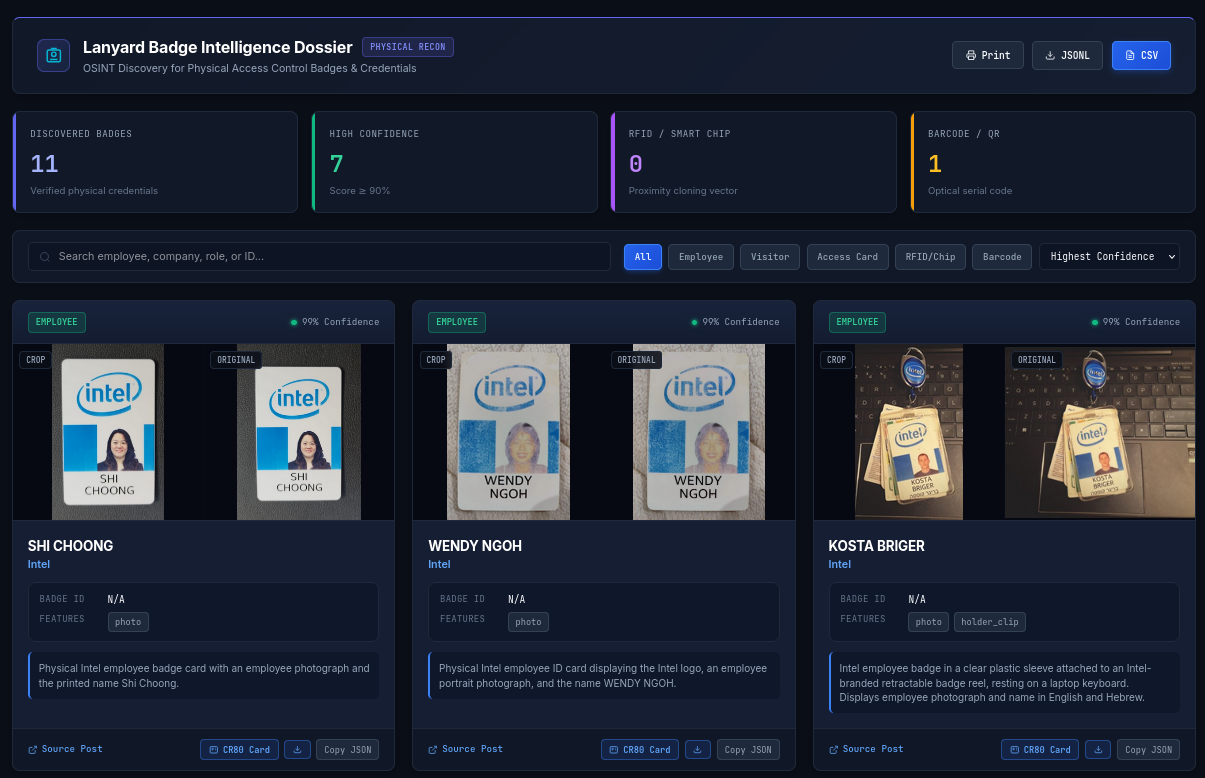
Table of Contents
Description
During physical penetration tests and red team engagements, cloning employee access badges or creating visual counterfeits requires high-resolution references. Employees frequently upload photos of their badges on LinkedIn when starting a new job, receiving a promotion, or finishing an internship.
lanyard automates this collection pipeline:
- Connects to LinkedIn via Camoufox to bypass bot detection.
- Searches company employee posts across multiple hiring and milestone angles.
- Steps through multi-photo albums and carousels to catch hidden slide attachments.
- Uses multimodal vision models to detect physical ID cards, extract cardholder details (names, roles, IDs), identify physical access markers (RFID chips, barcodes, magstripes), and locate card corners.
- Applies a perspective homography transform to deskew the badge into flat, 300 DPI CR80 dimensions (85.6mm x 54.0mm) ready for direct PVC card printing.
- Compiles all findings into an offline SQLite database, CSV, JSONL, and a local HTML inspection report.
Prerequisites
- Linux or macOS (tested on Kali Linux and Debian/Ubuntu)
- Python 3.12+
- Standard
piporuv
Installation
Lanyard works out of the box in standard Python environments using pip. You do not need uv to install or run the tool.
Quick Setup (Automated)
Run the setup script to detect your Python environment, configure dependencies (using uv if present, or falling back to standard venv and pip), download Camoufox browser binaries, and initialize local directories:
git clone https://github.com/shehzade/lanyard.git
cd lanyard
./setup.sh
Manual Installation (pip)
git clone https://github.com/shehzade/lanyard.git
cd lanyard
python3 -m venv .venv
source .venv/bin/activate
pip install -e .
camoufox fetch
Manual Installation (uv)
git clone https://github.com/shehzade/lanyard.git
cd lanyard
uv sync
uv run camoufox fetch
Configuration
When working inside your activated virtual environment, execute commands directly with lanyard <command>. If you prefer using uv without manually activating the virtual environment, prefix any command with uv run lanyard <command>.
LinkedIn Authentication
To search LinkedIn, provide an existing session. Two methods are supported:
Method 1: Import li_at cookie (Headless)
Copy the li_at cookie from your browser and import it:
lanyard cookie "AQEDAT..."Method 2: Interactive Browser Login
Opens a browser window to log in manually. The resulting session profile is saved locally to ~/.lanyard/:
lanyard loginVision Provider Setup
Lanyard supports Google Gemini, OpenAI, Anthropic, Ollama, and OpenRouter. You can configure credentials either by saving them to your local config (~/.lanyard/config.json) using lanyard config or by setting standard environment variables.
Google Gemini
lanyard config --provider gemini --gemini-key "AIzaSy..." --gemini-model "gemini-3.8-flash"
# Or: export GEMINI_API_KEY="AIzaSy..."
OpenAI
lanyard config --provider openai --openai-key "sk-..." --openai-model "gpt-4o"
# Or: export OPENAI_API_KEY="sk-..."
Anthropic
lanyard config --provider anthropic --anthropic-key "sk-ant-..." --anthropic-model "claude-3-7-sonnet-20250219"
# Or: export ANTHROPIC_API_KEY="sk-ant-..."
Ollama (Local / Air-Gapped)
ollama pull qwen2.5vl
lanyard config --provider ollama --ollama-model "qwen2.5vl" --ollama-base "http://localhost:11434"
# Or: export OLLAMA_BASE_URL="http://localhost:11434"
OpenRouter
lanyard config --provider openrouter --openrouter-key "sk-or-..." --openrouter-model "qwen/qwen-2.5-vl-72b-instruct"
# Or: export OPENROUTER_API_KEY="sk-or-..."
Inspect active configuration at any time:
lanyard config --showUsage
1. Company Badge Hunt
Target an organization and scrape public employee posts:
lanyard hunt -c "Acme Corp" --depth 5Options:
-c, --company: Target organization name.-d, --depth: Number of scroll pages to evaluate per query angle (default: 10).-t, --threads: Concurrent worker threads for vision analysis (default: 4).-o, --output: Directory to store media and database (default:./lanyard_output).-P, --provider: Override active vision backend (gemini,openai,anthropic,ollama,openrouter).-m, --model: Override model name for this scan.
Example targeting specific depth and output directory:
lanyard hunt -c "Acme Corp" --depth 12 --threads 4 -o ./acme_results2. Local Directory Analysis
Analyze an existing directory of photos directly without opening a browser:
lanyard analyze-dir ./photos/ -o ./photos_results --threads 43. Interactive Dossier Server
Serve the web gallery locally:
lanyard serve -o ./acme_results -p 8088Open http://127.0.0.1:8088/report.html in your browser. The gallery includes:
- Side-by-side view of original photos and cropped cards.
- CR80 perspective toggle for viewing the flat PVC badge layout.
- Pan and zoom controls for reading dense text, barcodes, and chip serials.
- Filter controls for badge type (employee, contractor, visitor).
Calibrated CR80 Card Reconstruction (300 DPI)
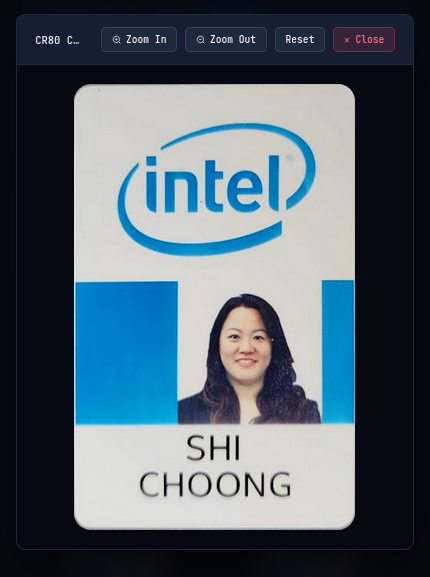
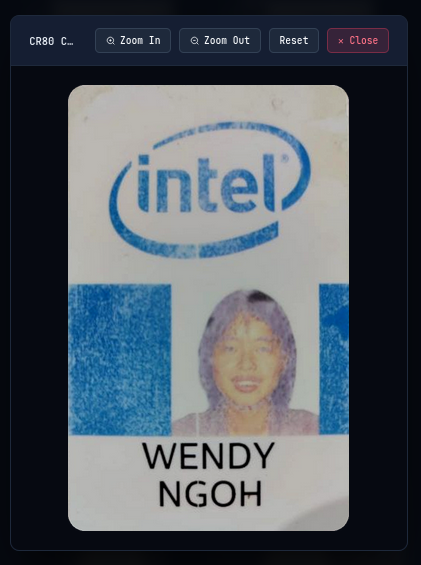
Lanyard detects badge boundary corners and applies a perspective homography matrix to output flat, print-ready PVC cards (85.6mm × 54.0mm):
| Shi Choong (Intel) | Wendy Ngoh (Intel) | Kosta Briger (Intel) |
|---|---|---|
 |
 |
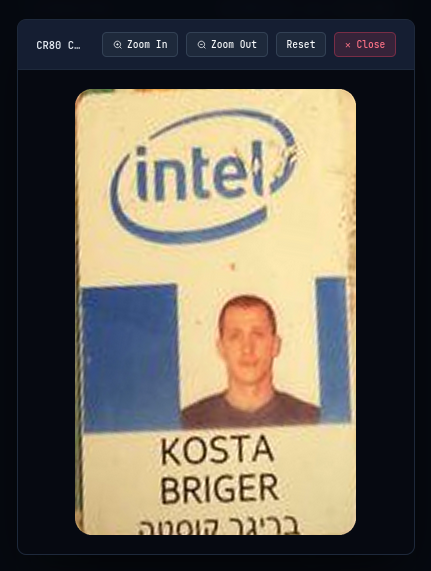 |
| Extracted: Name, Photo, Corporate Branding | Extracted: Name, Photo, RFID Geometry | Extracted: Dual-Language Typography, Badge Reel |
4. Exporting Reports
Regenerate HTML, CSV, and JSONL deliverables from an existing lanyard.db:
lanyard report -o ./acme_resultsOutputs
All collected assets are organized inside the specified output directory:
output_dir/
├── cr80/                  # Deskewed 300 DPI PVC cards (PNG and SVG)
├── crops/                 # Bounding box crops of identified badges
├── originals/             # High-resolution uncompressed downloaded photos
├── report.html            # Standalone visual report gallery
├── findings.csv           # Tabular export for spreadsheet analysis
├── findings.jsonl         # JSONL stream of structured findings and coordinates
└── lanyard.db             # SQLite database of images and detections
Supported Vision Models
| Backend | Default Model | Notes |
|---|---|---|
| Gemini | gemini-3.8-flash |
Fast inference, structured JSON output. |
| OpenAI | gpt-4o |
Structured output via json_schema strict mode. |
| Anthropic | claude-3-7-sonnet-20250219 |
Tool-use schema enforcement. |
| Ollama | qwen2.5vl |
Offline, local execution for air-gapped engagements. |
| OpenRouter | qwen/qwen-2.5-vl-72b-instruct |
Cloud endpoint for open-weight models. |
License
This project is licensed under the Apache License 2.0. See LICENSE for details.